The paradox of modern AI ambition: most organizations aren't suffering from a lack of ideas — they're suffering from a lack of architecture, both technical and cultural. Microsoft calls the answer Frontier Transformation: not a technology overlay, but a reimagining of how the enterprise aligns AI capability with human ambition. Here are the five moves the research identifies, and where we've watched each one succeed or fail in practice.
1. Stop building "fully baked" strategies — start with one measurable win
The most pervasive barrier to AI progress is the Grand Strategy fallacy: waiting for an all-encompassing plan before taking a first step. The organizations Microsoft calls Frontier Firms bypass that stagnation by anchoring transformation on a single, measurable use case — iteration over perfection, building the institutional trust that funds scaling.
Microsoft's BXT decision framework scores candidate use cases across Business impact, Experience, and Technology feasibility. The traits of a good first win: low-risk and high-volume; judgment-aware but rules-based; clear ROI; and staff openness. This is also the harder-edged reason to start small: independent MIT research found roughly 95% of generative AI pilots produce no measurable P&L return. The difference between the 95% and the rest isn't ambition — it's picking a win you can actually measure, then compounding it.
2. Data readiness is your critical path, not a side project
Fragmented data is the primary catalyst for hallucinated outputs and stalled adoption — if data stewardship is poor, AI systems cannot be trusted, and the research is blunt that this is where transformations die. The strategic view treats a unified semantic model as the linguistic foundation of the enterprise: when "customer" and "order" mean one thing everywhere, AI stops being confused by your own house.
3. The 67% rule: value is driven by culture, not code
In Microsoft's 2026 Work Trend Index — a 20,000-person, ten-market study — organizational factors like culture, manager support, and talent practices accounted for 67% of reported AI impact, more than double the 32% attributable to individual mindset and behavior. Demographics barely registered.
Read that carefully: scaling AI is less a technical challenge than an evolution of the operating model — from task execution toward human judgment, knowledge, and standards. The research's structural answer is a Center of Excellence that enables rather than gates: defining standards and responsible-AI practice, establishing shared platforms and reusable patterns, building role-based AI literacy, and wiring employee feedback loops back into guidance.
4. Move from disposable experiments to an "AI Factory"
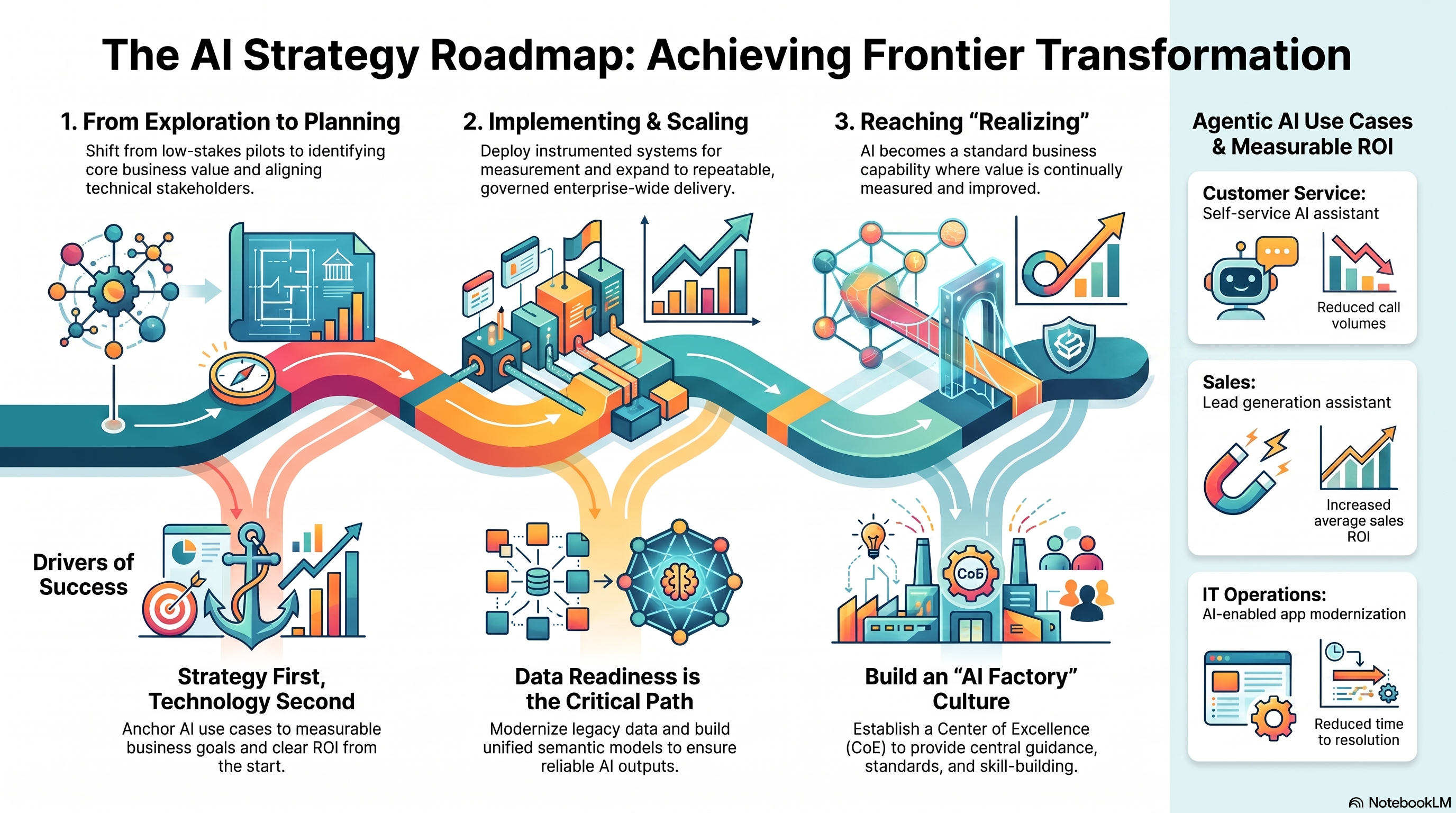
Getting from "Exploring" to "Realizing" means industrializing AI: GenAIOps, agentic DevOps, and a discipline where every project becomes a reusable blueprint — each deployment faster and cheaper than the last. The most consequential shift: growth decouples from headcount. Frontier Firms increase capacity through software, not proportional staffing. And the buy/extend/build discipline keeps the factory economical: buy ready-made SaaS for standardized workloads; extend managed platforms where you need custom logic on trusted infrastructure; build only where custom development is genuine competitive differentiation.
5. Change the narrative from "replacement" to "enabler"
Cultural rejection is the silent killer of AI ROI. The firms that succeed position agents as productivity tools that offload routine work — and as routine work commoditizes, human judgment becomes the premium currency: critical thinking as the final validation of AI output, creativity as the design of "why" and "what next," complex communication as the empathy agents can't reach. Structurally, that means the safe path must be the easy path: IT shifts from guardian-and-bottleneck to enabler, providing well-governed platforms where non-technical staff innovate inside guardrails rather than around them.
Beyond the destination
Frontier Transformation is continuous refinement, not a finish line — AI moving from add-on to core capability embedded in every business decision. Decouple growth from headcount, anchor your data in a unified (federated, governed) semantic foundation, and you move from isolated pilots into institutional advantage.
So the question worth asking your own organization: are you building isolated experiments — or the foundation for a business where AI and human ambition are finally in sync?
Find out which one you're building — in 2–3 weeks
UX4Tech's fixed-fee AI Readiness & Rescue Assessment scores your organization against the documented failure causes — data readiness first — and delivers a verdict you can take to your board. Request an Assessment »
Sources: Microsoft, The AI Strategy Roadmap (eBook); Microsoft 2026 Work Trend Index; MIT Project NANDA, State of AI in Business 2025. Practitioner perspectives paraphrased from interviews in Microsoft's research. UX4Tech is a Microsoft Partner; commentary is our own.