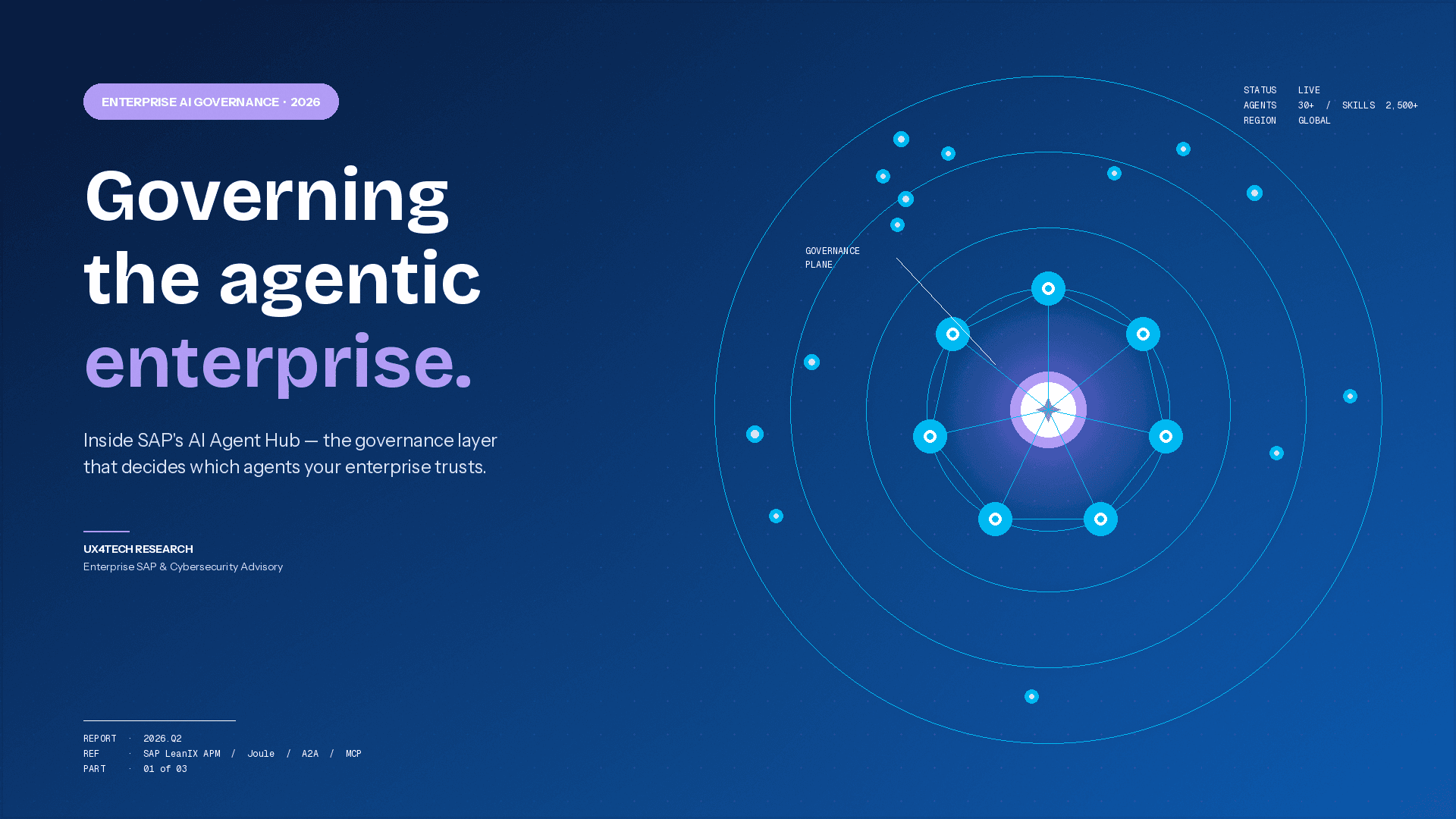
TL;DR — Why this is a 2026 inflection point
- 30+ specialized Joule agents and 2,500+ Joule Skills are deployed across SAP customer environments as of Q1 2026.
- The SAP AI Agent Hub is the answer to the obvious next question: who governs all of this?
- Anchor proof point: SAP LeanIX is a Leader in the 2025 Gartner Magic Quadrant for Enterprise Architecture Tools — positioned furthest and highest in both Completeness of Vision and Ability to Execute. First time for an SAP solution.
If you run SAP and you're piloting agents — Joule or otherwise — you're already on the runway for the same problem the industry hit with shadow IT in 2005. The Hub closes the gap before it opens.
1. What the SAP AI Agent Hub actually is
The AI Agent Hub is a feature set inside SAP LeanIX Application Portfolio Management. Calling it a "feature" understates it — in practice, it's the system of record for every AI agent operating across the enterprise, regardless of who built it or where it runs.
It does five things:
- Discovers agents automatically across SAP Joule, Google Vertex AI / Agentspace, Microsoft Copilot Studio, and (on the 2026 roadmap) AWS Bedrock.
- Maps each agent to the applications and business capabilities it touches.
- Governs the lifecycle: Proposed → Evaluated → Approved → Active → Retired.
- Reports to executives via dashboards on adoption, ROI, workforce impact.
- Routes employees to a curated, governed Agent Portal (currently in development).
The crucial framing: this is the governance plane, not the build plane. Joule Studio and SAP BTP build agents. The Hub watches them.

2. The shadow AI problem (and why this is happening now)
Every enterprise we talk to is in the same place: a few teams have piloted Joule, someone in marketing is using Copilot, the procurement team built a custom AWS Bedrock agent, and nobody upstream knows about any of it.
Sound familiar? It should — this is shadow IT in a new costume.
Without a system of record, you get:
- Duplicate agents doing identical work in different cost centers.
- Undocumented data access — agents pulling from systems no one approved.
- No clear owner when an agent makes a wrong decision that costs money or trust.
- Compliance exposure as autonomous actions accumulate without audit trails.
SAP's Global President of Customer Success has been blunt: failing to govern AI agents like you govern a human workforce exposes the organization to severe operational risk. That's not marketing language. That's the governance dilemma playing out at every Fortune 1000 right now.
The Hub responds with one non-negotiable rule: every agent passes through governed onboarding before it's active. Discovery Inbox catches them. Architects review them. Owners are assigned. Data scope is documented. Then — and only then — the agent goes live and is visible to compliance teams forever.
3. The six capabilities that matter
3.1 AI Agent Discovery (Live)
Pulls metadata via native integrations with SAP Business AI, Google Vertex AI / Agentspace, and Microsoft Copilot Studio. Uses the A2A protocol for cross-vendor discovery. Agents land in a Discovery Inbox where architects accept, link, or reject before promotion.
2026 expansion: AWS Bedrock Agents and AgentCore are on the roadmap, along with Microsoft MCP Registry scanning. Google + Microsoft are live; AWS is coming.
3.2 Application Landscape Visualization (Live)
Maps each agent to the applications it supports and capabilities it serves. Reveals coverage gaps — places where agents could remove manual work but haven't been deployed. This is where the Hub stops being a registry and starts being a planning tool.
3.3 AI Agent Radar (Live)
Lifecycle governance. Tracks every agent across Proposed → Evaluated → Approved → Active → Retired. Records policy compliance, data access scope, usage. Creates the defensible audit trail that legal and internal audit will eventually ask for.
3.4 Meta Model Extension for AI Agents (Live)
Treats AI Agent as a formal sub-type of Application in the LeanIX meta model. Standard attributes: capabilities, risk level, owner, data sources, autonomy boundaries. Unsexy but pays off at scale — you can run cross-portfolio analytics (compare agents by risk, owner, business capability, lifecycle stage) because everything's modeled the same way.
3.5 Executive Dashboard (Partial — Full version Q2 2026)
CIO / CTO / CDO / board view. Active agents, newly onboarded, retired, interaction volume, success rate, resolution time, workforce impact via SuccessFactors, ROI proxies. The full Executive Summary Dashboard is on the Q2 2026 roadmap.
3.6 AI Agent Portal (In development)
Employee-facing curated app store of approved agents. Removes the temptation to grab whatever ChatGPT plugin a colleague mentioned. The Portal is the demand-side fix to shadow AI — make the safe choice the easy choice. Currently in development; verify status with your SAP account team.
4. How it fits with the rest of SAP
The Hub doesn't live alone — it sits on top of an integration ecosystem that's been quietly building for two years.
SAP Signavio (process mining): identifies which business processes would benefit from automation, then suggests relevant agents. Joule went GA in Signavio in Q1 2026 with natural-language process search.
SAP SuccessFactors: captures the workforce impact of agent rollout — skill shifts, reskilling needs, capability gaps. Bridges technical deployment with HR planning. This is the integration most enterprises don't think about until it's too late.
SAP BTP / SAP Build: agents built in Joule Studio automatically flow into the LeanIX inventory pipeline. Custom pro-code agents register via the A2A "Bring Your Own Agent" pattern using the SAP Cloud SDK for AI. The new Joule Studio Code Editor (a VS Code IDE extension) and Joule Studio CLI launched in Q1 2026, opening the agent-build workflow to professional developers.
SAP Cloud ALM / SAP4Me: operational lifecycle — activation, monitoring, support. The Hub governs the what and who; Cloud ALM runs the how in production.
5. The open standards bet: A2A and MCP
This is where SAP makes its most interesting move. Rather than building a closed agent ecosystem, SAP has committed to open protocols invented and stewarded by the broader industry:
Agent-to-Agent (A2A) is the open standard for cross-vendor agent collaboration. It was launched by Google at Cloud Next 2025 with 50+ technology partners — SAP among the founding contributors. At SAP TechEd 2025 in November, SAP announced full A2A support for Joule Agents, enabling external systems (Google Vertex AI, Microsoft Copilot Studio, AWS Bedrock, custom apps) to consume Joule capabilities via the upcoming Agent Gateway. Inside the Hub, A2A is what powers cross-vendor Discovery.
Model Context Protocol (MCP) standardizes how agents discover and interact with tools and data sources. SAP HANA Cloud MCP Server is live now (relational + spatial + vector data in one in-memory engine). LeanIX has its own MCP Server. At NRF 2026, SAP announced the Storefront MCP for SAP Commerce Cloud, planned Q2 2026.
Notably, SAP's Q1 2026 release notes confirm SAP supports MCP, A2A, ACP, and UCP (Universal Commerce Protocol) — a multi-protocol posture, not a single-bet one.
For enterprises, the practical implication is meaningful: you're betting on standards the rest of the industry is also adopting. Lock-in risk is substantially lower than a SAP-only or single-vendor agent strategy.
6. What the Hub doesn't cover (the gaps we see)
This is where we shift from explainer to opinion. We've been advising SAP customers on AI security and architecture for the past 18 months. Here's what the Hub does not solve — that you still have to:
Trust scoring. The Hub records agent metadata, lifecycle state, and policy compliance — but it doesn't evaluate whether an agent is trustworthy. Did this agent's outputs hold up under adversarial testing? Has it drifted since approval? What's its confidence on edge cases? You need a separate evaluation layer for that. (This is what NextGenIQ does — disclosure: it's our sister product.)
Cross-platform conflict detection. If Agent A in Salesforce books a vendor for Tuesday and Agent B in S/4HANA reschedules them to Wednesday, who reconciles? The Hub sees both agents as governed individually. It doesn't see the collision.
Real-time autonomy control. Agent Radar records whether an agent passed governance review. It doesn't intercept real-time autonomous actions and gate them based on context. For high-stakes domains (finance, clinical, supply chain), you'll need an additional control layer.
Build-vs-buy economics. The Hub will tell you which capabilities you've covered with agents. It won't tell you whether you should have built them, bought them, or done neither. That's still a human architectural call.
None of these gaps are reasons not to deploy the Hub. They're reasons to deploy the Hub and a deliberate strategy for the categories above. We help clients design that strategy.
7. UX4Tech's recommendation: how to actually adopt this
Phase 1 — Foundation (Months 1-2): Activate LeanIX APM, enable the Hub, configure the meta model extension for AI Agents. Connect SAP-native integrations (BTP, Build, Business AI). Run initial discovery scan. The output: a complete inventory of every SAP-native agent currently in your environment, with owner and data scope documented.
UX4Tech tip: Don't skip the meta model configuration even if it feels like setup busywork. Six months in, when you're trying to compare agents by risk tier across business units, you'll wish every agent had been classified consistently from day one.
Phase 2 — Governance Activation (Months 3-4): Enable Agent Radar lifecycle stages. Configure compliance policies. Connect Signavio and SuccessFactors. Connect Google and Microsoft discovery. Pilot the Agent Portal as it matures.
UX4Tech tip: This is where the political work begins. Activating Agent Radar means agents that didn't go through governance can no longer be active. Get executive sponsorship before flipping that switch — or you'll have angry product owners on day one.
Phase 3 — Multi-Cloud Expansion (Months 5-6): AWS Bedrock discovery as it lands. MCP Registry scanning. Agent Gateway for external A2A consumption. Executive Summary Dashboard.
Phase 4 — Optimization & Scale (Months 7-12): Use Hub data to drive investment decisions. Identify coverage gaps via Landscape View. Prioritize next agent rollouts based on Signavio recommendations. Reskill workforce based on SuccessFactors signals. Retire inactive agents semi-annually.
8. Pricing realism
The AI Agent Hub is included in SAP LeanIX APM's base tier — per-application pricing with unlimited users. SAP doesn't publish list prices; you'll get a custom quote through your account team or partner.
SAP Business AI (the agent runtime layer) is separately priced under a Base AI + Premium AI model: per-user-per-month for assigned users, consumption-based for high-volume API agents. Generative AI Hub has a 30-day free trial.
UX4Tech tip: Model the SAP Business AI consumption-based pricing carefully before you scale. We've seen pilots where a single high-volume agent (think: customer support chatbot, document classifier) consumed more than the entire LeanIX APM license cost in a quarter. The Hub is cheap. The agents it governs may not be.
9. Who else is in this space (and why they're not really competing)
Microsoft has Copilot Studio, Salesforce has Agentforce, ServiceNow has its AI Agents — but each governs only the agents in its own ecosystem. None maps agents to enterprise architecture or business capabilities. None integrates process mining or workforce impact tracking.
The Hub's actual differentiator is that it sits above the build platforms, not inside one. That's a structural advantage no single-vendor agent platform can match without rebuilding the LeanIX EA layer underneath.
For SAP customers, the practical upshot: the Hub is the only path to one governance plane across all your agents, not four governance planes that each cover a quarter of them.
10. What to do this week
If you're an SAP customer who has even one Joule agent in production, three actions:
- Ask your SAP account team about LeanIX APM with the AI Agent Hub feature set. Even if you're not buying yet, get a demo. It changes the architecture conversation.
- Inventory your current agents manually — every Joule pilot, every Copilot connector, every Bedrock agent your teams have built. You will be surprised by what's in production already.

- Define your governance principles before the Hub forces you to. The seven pillars from SAP's framework (Lifecycle Management, Autonomy Boundaries, Policy Enforcement, Continuous Monitoring, Audit Trails, Human Escalation, Sovereignty) are a working starting point.
If you want help thinking through the strategy, the architecture, or the trust/evaluation layer that sits alongside the Hub — that's what we do.
About UX4Tech. We help enterprises build and govern AI capabilities on SAP. Services span SAP security (vCISO), SAP GRC, SAP technical advisory, agent compliance, and AI security. Our vCISO chatbot can answer detailed questions on this topic with citations from official SAP sources.
Related reading:
- SAP Business AI Q1 2026 Release Highlights
- SAP Help Docs — AI Agent Hub
- SAP Architecture Center — Build AI Agents
- SAP LeanIX Product Roadmap
Compiled from official SAP documentation, SAP LeanIX product resources, SAP Q1 2026 release notes, SAP Architecture Center AI Golden Path, and SAP Community sources, May 2026. Independently fact-checked. UX4Tech opinions are our own.

